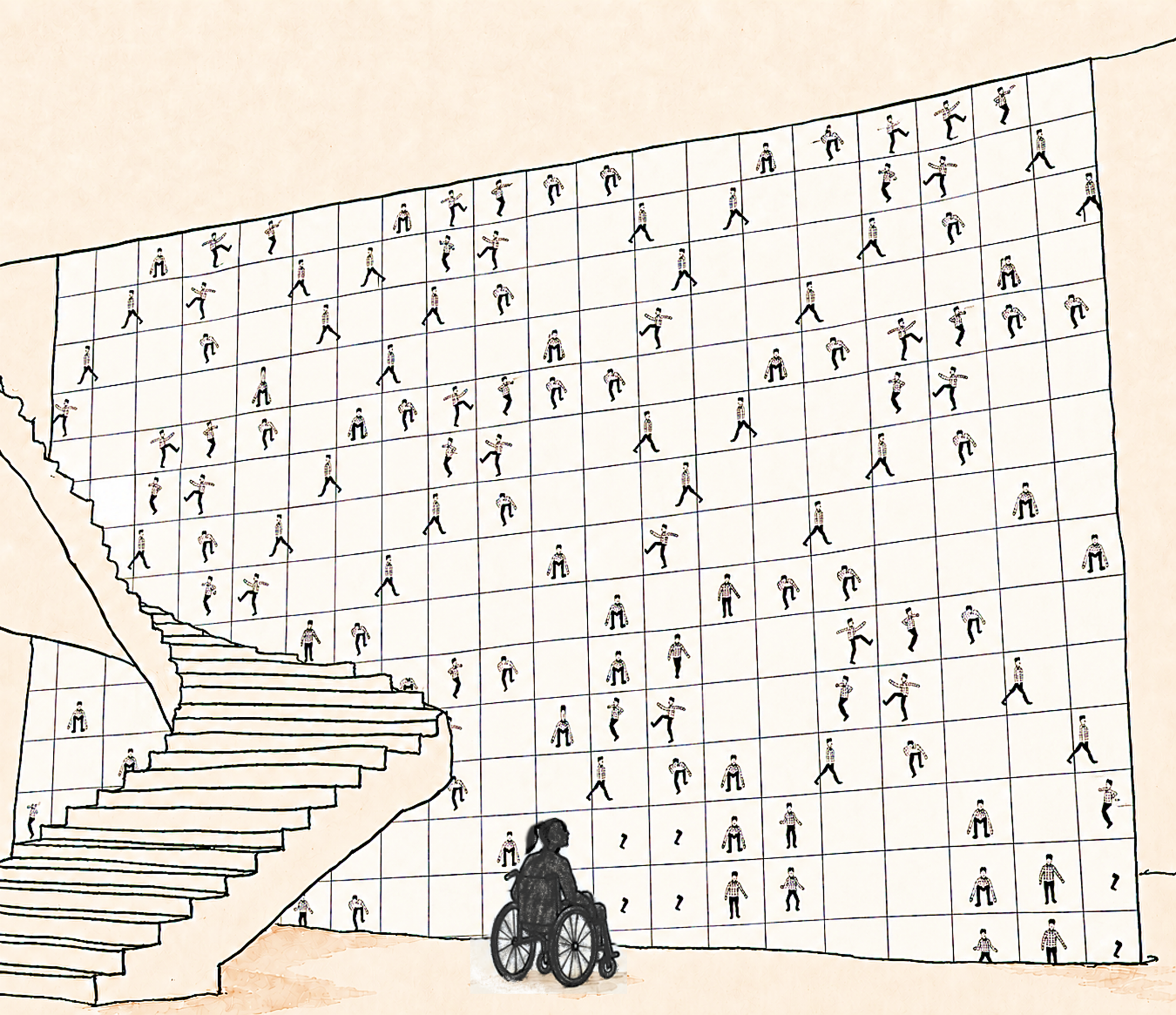
Estudo de instalação: painel de LED com padrão figurativo, integrado à arquitetura
Animating the Grid: Cellular Automata as Evolving Visual Narratives
(Português abaixo)
Animating the Grid (Dramaturgia da grade)
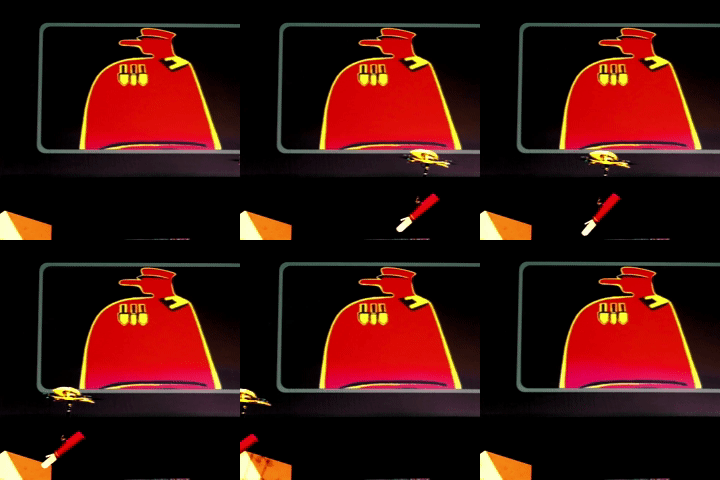
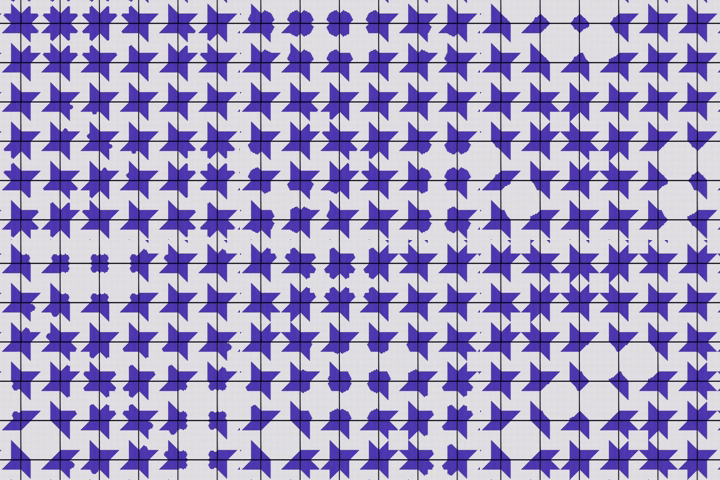
Uma colaboração com o físico computacional Disrael Camargo, a série explora a interseção entre a tradição dos murais de azulejos e as mídias digitais. Animating the Grid leva os murais de autômatos celulares da dupla um passo adiante em relação ao projeto anterior, Bulcanico, que apresenta formas abstratas, para figuras animadas. Nesta série, cada azulejo do mural contém uma pequena animação desenhada à mão, e pássaros, minhocas, trepadeiras e pessoas se movem pela grade seguindo regras computacionais.
A ideia central é a troca de vocabulário. Nos autômatos celulares, cada célula de uma grade guarda um estado, tradicionalmente representado por uma cor, que muda passo a passo conforme o estado das células vizinhas. Aqui, cada estado corresponde a um gesto: andar, pular, brotar, fugir, desaparecer. As regras continuam simples e locais, mas o que elas organizam é uma gramática de ações desenhadas quadro a quadro, e o mural inteiro se torna uma coreografia que ninguém compôs de antemão.
Cada azulejo alterna entre vazio e ocupado, em sequência coordenada com seus vizinhos, e todas as animações compartilham o mesmo número de quadros e os mesmos pontos de início e fim, para que as transições se encaixem sem cortes. Quando um pássaro parece atravessar o mural, o que acontece é uma onda de estados se propagando de célula em célula.
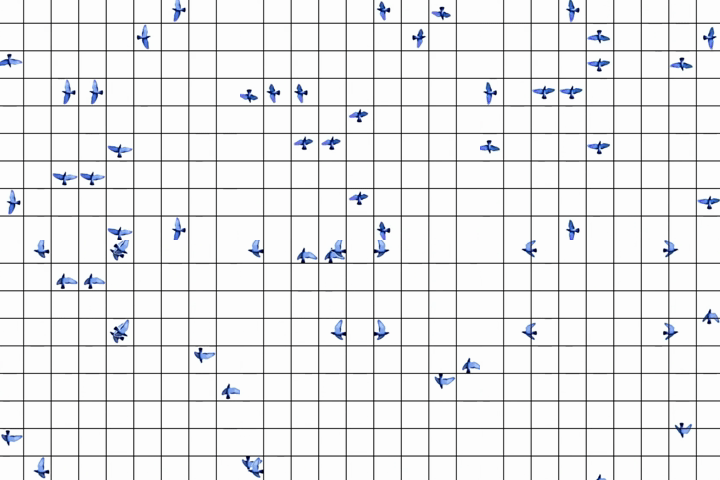
A série reúne quatro murais, cada um com sua própria regra e temperamento. Em Passaros, os pássaros voam em linha reta e mudam de direção quando colidem de frente. Em Minhocas, frentes ramificadas de minhocas nascem e morrem continuamente, umas chegando dos azulejos vizinhos, outras brotando da terra. Em Trepadeiras, uma regra do acaso faz com que a vegetação colonize a grade lentamente, formando e desfazendo composições. E, em Humanos, o mais complexo, um homem multiplicado entra por portas e paredes, vagueia, atravessa fronteiras entre azulejos e, ocasionalmente, chuta o vizinho, num humor herdado do cinema de Norman McLaren e das silly walks do Monty Python.
O resultado é uma dramaturgia fragmentada na qual situações dramáticas provisórias surgem, se repetem e se desfazem, sem protagonista nem enredo fixos, ao mesmo tempo na escala do azulejo, onde cada gesto é legível de perto, e na escala da parede, onde uma população inteira se move. Por enquanto, os murais existem em tela, documentados em vídeo, mas foram concebidos para o espaço construído, onde o espectador possa se aproximar de uma única figura ou recuar e ver a multidão.
Animating the Grid
A collaboration between artist Julia Zamboni and computational physicist Disrael Camargo, Animating the Grid takes the duo's cellular-automaton murals one step further: from abstract forms to living figures. In this series, each tile of the mural holds a small hand-drawn animation, and birds, worms, vines, and people move across the grid following computational rules.
The central idea is a change of animation vocabulary within the grid. In cellular automata, each cell of a grid holds a state, traditionally a color or a shape, that changes step by step according to the states of its neighbors. Here, each state corresponds to a gesture: walking, jumping, sprouting, fleeing, vanishing. The rules remain simple and local, but what they organize is a grammar of frame-by-frame drawn actions, and the whole mural becomes a choreography that no one composed in advance.
Movement across the grid is, in fact, a built illusion. No figure actually travels: each tile merely switches between empty and occupied, in coordinated sequence with its neighbors, and every animation shares the same number of frames and the same starting and ending points, so that transitions lock together without cuts. When a bird seems to cross the mural, what is really happening is a wave of states propagating from cell to cell.
The series comprises four murals, each with its own rule and its own temperament. In Birds, birds fly in straight lines and change direction when they collide head-on. In Worms, branching fronts of worms are continually born and die, some arriving from neighboring tiles, others surfacing from the earth. In Vines, a rule with an element of chance lets vegetation slowly colonize the grid, forming and dissolving compositions. And in Humans, the most complex, a multiplied man enters through doors and walls, wanders, crosses boundaries between tiles, and occasionally kicks his neighbor, in a humor inherited from Norman McLaren's films and Monty Python's silly walks.
The result is a fragmented dramaturgy: provisional dramatic situations arise, repeat, and dissolve, with no fixed protagonist or plot, at once at the scale of the tile, where each gesture is legible up close, and at the scale of the wall, where an entire population moves. For now the murals exist on screen, documented on video, but, like all of the duo's research, they were conceived for built space, where a viewer can step close to a single figure or step back and watch the crowd.