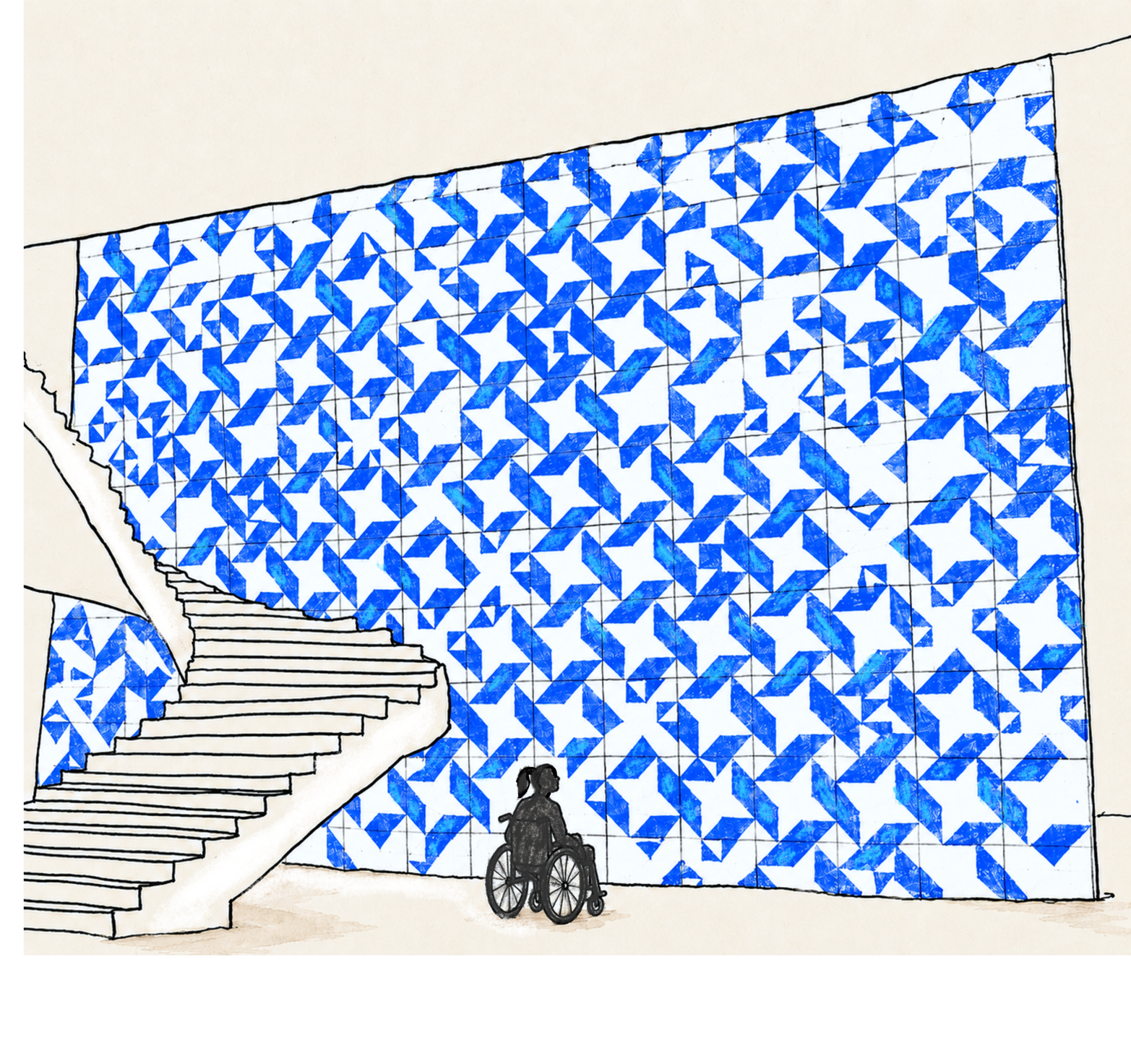
Visualização da série em escala arquitetônica
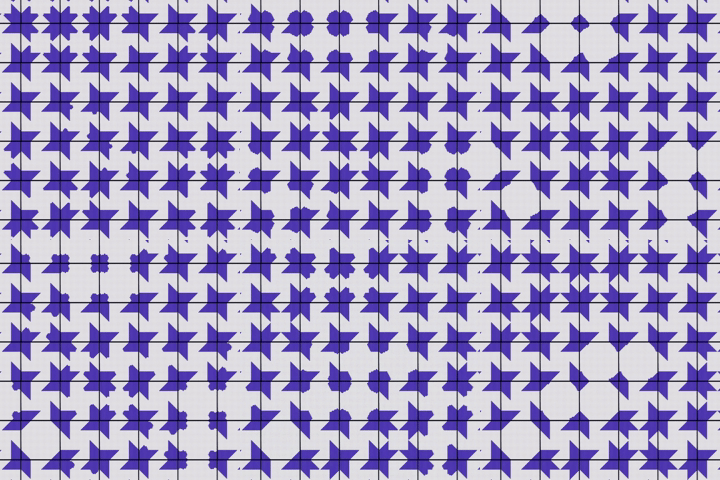
Bulcânico
(English below)
Uma colaboração entre a artista Julia Zamboni e o físico computacional Disrael Camargo, a série Bulcânico explora a interseção entre a tradição dos murais de azulejos e as mídias digitais.
A série presta homenagem a Athos Bulcão, artista cujos murais de azulejos definem a paisagem de Brasília. Bulcão não desenhava composições prontas para seus murais. Ele criava módulos de azulejo e deixava que os operários de cada obra os organizassem livremente, em padrões não periódicos. O que ele entregava a um edifício, portanto, não era uma imagem, mas um sistema, um pequeno conjunto de peças e as regras de combinação entre elas.
É esse sistema que a série herda e coloca em movimento. Usando autômatos celulares, que são modelos computacionais em que regras locais simples dão origem a comportamentos complexos e imprevisíveis, os murais digitais do Bulcânico nunca se repetem. Cada azulejo é uma célula cujo estado muda passo a passo conforme os estados de seus vizinhos, resultando em um mural em transformação contínua. O que se vê não é uma composição fixa, mas a própria passagem de um padrão a outro.
Cada mural é construído sobre três níveis de tesselação, os azulejos, os triângulos grandes que os compõem e os triângulos pequenos dentro deles, com regras de autômato celular atuando em duas dessas escalas ao mesmo tempo. As transições nascem de uma "semente": um triângulo muda de estado e se espalha gradualmente para os vizinhos, criando uma onda de mudança que varre o azulejo até se estabilizar em um novo padrão.
A série reúne cinco murais. Os quatro primeiros (Bulcânico I a IV) compartilham a mesma lógica, grades de azulejos azuis e brancos regidas por regras de vizinhança que impedem saltos bruscos na densidade de cor, enquanto cada um explora um vocabulário visual próprio, do gradiente suave ao jogo de figura e fundo. O quinto, Bulcânico V, introduz uma dimensão de escala: os módulos dos azulejos podem se subdividir em partes menores ou se fundir de volta, adicionando profundidade ao plano do mural.
Até aqui, os murais existem em tela, mas nasceram pensando na arquitetura. Assim como os azulejos de Bulcão só se revelam por inteiro no espaço construído, vistos de relance por quem não os procurava, o horizonte da série é a escala arquitetônica: painéis de LED ou projeções integradas a paredes e fachadas.
****** English ******
A collaboration between artist Julia Zamboni and computational physicist Disrael Camargo, the Bulcânico series explores the intersection between the tradition of tile murals and digital media.
The series pays homage to Athos Bulcão, the artist whose tile murals define the landscape of Brasília. Bulcão did not design finished compositions for his murals. He created tile modules and let the workers at each building site arrange them freely, in non-periodic patterns. What he delivered to a building, then, was not an image but a system: a small set of pieces and the rules for combining them.
It is this system that the series inherits and sets in motion. Using cellular automata, which are computational models in which simple local rules give rise to complex, unpredictable behavior, the digital murals of Bulcânico never repeat themselves. Each tile is a cell whose state changes step by step according to the states of its neighbors, resulting in a mural in continuous transformation. What you see is not a fixed composition, but the very passage from one pattern to the next.
Each mural is built on three levels of tessellation, the tiles, the large triangles that compose them, and the small triangles within those, with cellular-automaton rules acting on two of these scales at once. Transitions are born from a "seed": one triangle changes state and gradually spreads to its neighbors, creating a wave of change that sweeps across the tile until it settles into a new pattern.
The series comprises five murals. The first four (Bulcânico I through IV) share the same logic, grids of blue and white tiles, governed by neighborhood rules that prevent abrupt jumps in color density, while each explores its own visual vocabulary, from soft gradients to figure-ground play. The fifth, Bulcânico V, introduces a dimension of scale: tile modules can split into smaller parts or merge back together, adding depth to the plane of the mural.
So far, the murals exist on screen, but they were born with architecture in mind. Just as Bulcão's tiles only reveal themselves fully in built space, glimpsed in passing by people who never sought them out, the horizon of the series is the architectural scale: LED panels or projections integrated into walls and façades.